By Fitness Eddy Editorial
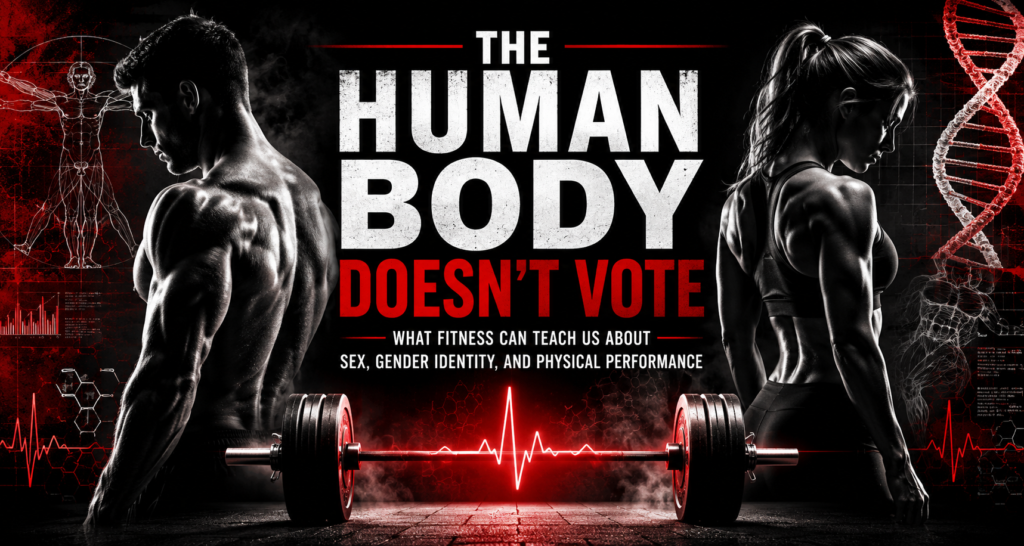
The Human Body Doesn’t Vote: What Fitness Can Teach Us About Sex, Gender Identity, and Physical Performance
Explore related Fitness Eddy guides and collections: Functional Fitness vs Traditional Fitness · Functional Fitness Workout for Beginners · Active Recovery
Introduction: The Weight on the Bar Doesn’t Know Your Politics
Walk into any gym in the world.
It doesn’t matter whether you’re in New York, Nairobi, Tokyo, London, São Paulo, or Doha.
The squat rack doesn’t care who you voted for.
The treadmill doesn’t recognize your ideology.
Gravity doesn’t ask your pronouns.
A 100-kilogram barbell weighs exactly the same today as it did fifty years ago.
Yet outside those gym walls, one of the most emotionally charged debates of our generation continues to unfold.
What does it mean to be male?
What does it mean to be female?
Can gender identity reshape how we think about the human body?
And perhaps the question that has become almost impossible to ask without provoking outrage:
Does biology still matter?
For some, the answer is obvious.
For others, even asking the question sounds like taking a political side.
But science rarely works that way.
The human body doesn’t care about our elections, our hashtags, our political parties, or our social media arguments.
It responds to hormones.
To genetics.
To nutrition.
To training.
To sleep.
To injury.
To time.
The irony is striking. At the very moment society has become more divided over sex and gender than perhaps at any point in modern history, exercise science has never been more advanced.
Never have we understood more about muscles.
About hormones.
About strength.
About endurance.
About recovery.
About human performance.
Yet public conversations often generate more heat than light.
Instead of asking, “What does the evidence tell us?” we increasingly ask, “Which side are you on?”
Maybe we’re asking the wrong question.
The Gym: One of the Last Honest Places
There is something strangely democratic about a gym.
A billionaire cannot pay a dumbbell to become lighter.
An Olympic champion cannot negotiate with gravity.
A beginner cannot skip adaptation.
Progress has always required the same currency:
Consistency.
Discipline.
Recovery.
Time.
This is one of the reasons fitness has fascinated scientists for decades.
Unlike many areas of life, physical performance leaves measurable clues.
Muscle fibers either grow—or they don’t.
Bones either adapt—or they don’t.
VO₂ max improves—or it doesn’t.
Recovery speeds up—or it doesn’t.
Nature keeps records.
The body remembers every workout.
It also remembers every shortcut.
Steroids.
Sleep deprivation.
Poor nutrition.
Aging.
Injury.
No amount of ideology changes biology’s accounting system.
Sex and Gender: Two Different Questions
One reason this conversation becomes so difficult is because two distinct concepts are often discussed as though they are interchangeable.
Biological sex generally refers to physical characteristics such as chromosomes, reproductive anatomy, and many physiological traits that influence human development.
Gender identity refers to a person’s internal sense of who they are.
For many people, those align. For others, they do not.
Recognizing that distinction doesn’t answer every policy question, but it helps clarify the conversation.
When discussing dignity, identity, or social recognition, gender identity is central.
When discussing muscle physiology, oxygen transport, or skeletal mechanics, biological characteristics often become more directly relevant.
Keeping those questions separate can make discussions more productive.
The Body Is an Engineering Marvel
Strip away politics for a moment.
Imagine looking at the human body as though it were a machine designed by engineers.
Every organ has a purpose.
Every hormone has a function.
Every adaptation comes with trade-offs.
Muscle is expensive tissue.
Bone remodels itself under load.
The heart becomes more efficient through training.
The lungs adapt.
The nervous system becomes faster.
The body is constantly responding to stress.
Fitness is not about defeating biology.
It is about working with it.
That is why coaches speak the language of adaptation rather than ideology.
The body responds to repeated demands over time, regardless of the story we tell ourselves about those demands.
Why Elite Sport Is Different
The debate becomes especially intense in elite competition because sport is built on categories.
We divide athletes by age.
By weight.
Sometimes by disability classification.
Often by sex.
These divisions exist because competitors are not physically identical.
The purpose of categories is not to declare one group superior to another but to create meaningful competition.
Questions arise when different values intersect: inclusion, fairness, and safety.
Different sports organizations have reached different conclusions, and policies continue to evolve as new research emerges.
Reasonable people can disagree about where the balance should lie.
What matters is that those discussions engage seriously with the available evidence rather than assuming there is a simple answer.
The Influence of Social Media
If biology shapes the body, culture shapes how we see it.
Scroll through Instagram.
TikTok.
Facebook.
Almost every platform rewards transformation.
Not health.
Transformation.
The before-and-after photo.
The impossible six-pack.
The perfect glutes.
The veins.
The jawline.
The filters.
The lighting.
The editing.
Sometimes the pharmaceuticals.
Social media has changed fitness from something we do into something we perform.
It has amplified expectations for everyone.
Men are encouraged to be larger, leaner, and stronger.
Women are encouraged to be lean, toned, and curvy—often all at once.
These ideals can motivate some people, but they can also fuel unrealistic expectations and body dissatisfaction.
What the Body Actually Rewards
Despite the noise, the body’s feedback remains remarkably consistent.
It rewards progressive training.
Adequate protein.
Good sleep.
Recovery.
Patience.
It punishes shortcuts.
It adapts slowly.
It changes over years, not overnight.
Perhaps that’s one reason fitness can feel grounding in a fast-moving world.
The body doesn’t respond to trends nearly as quickly as social media does.
The Bigger Question
Perhaps the most important lesson fitness offers has little to do with politics.
It reminds us that human beings are both biological and social.
We have identities, cultures, beliefs, and communities.
We also have muscles, bones, hearts, lungs, hormones, and nervous systems.
Reducing people to only biology misses part of the story.
Ignoring biology altogether misses another.
The challenge isn’t choosing one over the other.
It’s learning when each is most relevant.
Conclusion: Listening to the Body
Fitness has always been about learning to listen.
To notice what helps us grow.
To recognize our limits.
To respect our differences.
To celebrate improvement rather than perfection.
The debates over sex, gender identity, and physical performance are unlikely to disappear soon.
If anything, they will become more prominent as science advances and society continues to wrestle with questions of fairness, inclusion, and identity.
But perhaps the gym offers an unexpected lesson.
The weight doesn’t care what argument won on television last night.
The stopwatch doesn’t know which opinion trended online.
The body doesn’t vote.
It adapts.
And maybe, before we ask the body to fit our politics, we should spend more time asking what it has been trying to teach us all along.