
Active Recovery 101: Why Mobility Tools Are Non-Negotiable for Muscle Growth
In the fitness world, the “no pain, no gain” dogma has long led people to believe that progress is exclusively forged under heavy iron and breathless conditioning. But here is the truth seasoned athletes and physical therapists know: muscle growth does not happen in the gym; it happens during recovery.
Pushing your body to the limit without a structured post-workout restoration plan leads straight to chronic stiffness, plateaus, and overtraining syndrome. If you want to maximize your hypertrophy and longevity, integrating active recovery and targeted mobility tools into your routine isn’t just a bonus—it is non-negotiable.
Explore related Fitness Eddy guides and collections: Functional Fitness at Home · Functional Fitness Equipment · Recovery & Mobility · Functional Fitness Workout for Beginners
What is Active Recovery and Why Does Passive Rest Fall Short?
To understand how to recover effectively, you first need to distinguish between the two primary types of rest:
- Passive Rest: Complete inactivity, such as sitting on the couch or sleeping. While sleep is vital, sitting completely idle does little to stimulate blood circulation or alleviate localized muscle stiffness.
- Active Recovery: Low-intensity physical movement that keeps the heart rate slightly elevated, promoting systemic blood circulation without adding mechanical or systemic fatigue.
The Physiology of Recovery
When you lift heavy weights or grind through intense conditioning, you create microscopic tears in muscle fibers while accumulating metabolic byproducts like lactate and hydrogen ions within the tissue.
Passive rest relies entirely on your body’s baseline circulation to clear these waste products and deliver amino acids and oxygen to damaged cells. Active recovery and soft-tissue work actively accelerate this process. By encouraging capillary blood flow, you act as an internal pump, flushing metabolic waste out of the muscle belly and rushing nutrient-rich blood straight to the areas that need repair.
The Science of Mobility: How Soft Tissue Work Supports Hypertrophy
Mobility is often confused with flexibility, but they are entirely different metrics. Flexibility is passive—it measures how far a joint can be moved through an external force. Mobility is active—it measures your ability to move a joint through a full range of motion under your own muscular control.
Breaking Down Fascia Restrictions
Muscles are wrapped in a web of dense connective tissue called fascia. When you subject your body to repetitive, high-load resistance training or long periods of sedentary posture, fascia can become dehydrated, bound down, and restricted.
These myofascial adhesions create “friction” between muscle layers, limiting your freedom of movement. If your joints and tissues are locked up, you cannot achieve full range of motion during compound movements like squats, deadlifts, or overhead presses.
The Hypertrophy Connection
Maximizing muscle hypertrophy requires generating maximum mechanical tension across a full range of motion. If restricted fascia or tight tissue cuts your range of motion short by even 10%, you are leaving gains on the table. Targeted mobility work breaks up these restrictions, allowing your muscles to contract and stretch fully under load, translating directly to superior muscle fiber recruitment and growth.
The Essential Active Recovery Toolkit for Your Home Gym
You do not need a commercial spa to recover like a pro. Building a versatile home toolkit requires just a few key pieces of equipment designed to target the nervous system and soft tissue.
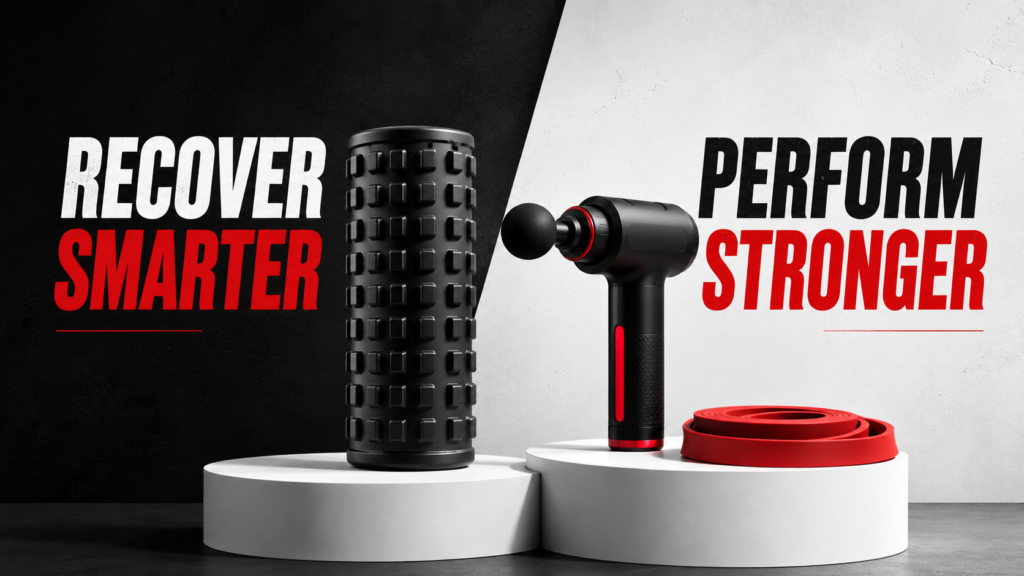
High-Density Foam Rollers (Myofascial Release)
Foam rolling acts as a form of self-myofascial release (SMR). Beyond mechanical tissue work, rolling triggers a profound neurological response. Slow, deliberate pressure on a high-density foam roller signals the central nervous system to down-regulate the sympathetic nervous system (shifting your body out of “fight or flight” and into “rest and digest”), lowering overall muscle tone and reducing post-workout tension.
Percussive Therapy Devices (Massage Guns)
Massage guns use rapid, high-frequency vertical pulses to penetrate deep into muscle tissue. A quality percussive therapy massage gun helps disrupt pain signals traveling to the brain, increases localized blood flow, and loosens up stubborn knots in hard-to-reach areas like the upper back, lats, and calves. They are an efficient way to stimulate superficial blood flow within minutes.
Resistance Bands & Stretching Straps
Light durable resistance bands are invaluable for active isolated stretching. Unlike static stretching—which can temporarily decrease power output if performed pre-workout—band-assisted mobility work allows you to gently traction joints, lubricate the joint capsule, and elongate shortened muscle bellies safely post-training.
How to Build a 15-Minute Post-Workout Mobility Routine
You don’t need an hour-long stretching session to reap the benefits of active recovery. Implement this straightforward, 15-minute protocol immediately following your next training session:
- Minutes 1–3: The Cardiovascular Flush
- Keep moving at a very low intensity. Walk on a treadmill, spin slowly on an upright bike, or pace your floor. This keeps blood pumping as your heart rate gradually steps down.
- Minutes 4–10: Targeted Self-Myofascial Release
- Spend 60 to 90 seconds per major prime mover used during your workout (e.g., quads, hamstrings, lats, upper back). Roll slowly over your FitnessEddy foam roller, pausing on tender spots until you feel the tissue release.
- Minutes 11–15: Dynamic Mobility & Band Stretches
- Transition to active holds and band-assisted stretches. Focus on opening up tight hips, thoracic spine extensions, and shoulder mobility to lock in your newly restored range of motion.
Frequently Asked Questions (FAQ)
Should I use mobility tools before or after training?
Use dynamic movements and light movement prep before your workout to elevate body temperature and lubricate joints. Save deep foam rolling with a FitnessEddy roller, aggressive percussive therapy with a massage gun, and static mobility work for after your workout or on dedicated rest days to support recovery without compromising strength output.
How many active recovery days should I incorporate per week?
Aim for 1 to 2 dedicated active recovery days per week (such as light swimming, long walks, or a dedicated 30-minute mobility session), alongside a 10-to-15-minute cool-down routine following every heavy lifting session.
Can foam rolling permanently lengthen muscle tissue?
No. Foam rolling does not structurally alter or stretch the physical length of a muscle or fascia permanently. Instead, it works via neurological relaxation—decreasing muscle spindle sensitivity and down-regulating resting muscle tone so you can move without artificial restriction.
Ready to upgrade your recovery routine? Explore the full FitnessEddy Recovery & Mobility Collection featuring durable, pro-grade mobility tools, high-density foam rollers, and recovery tech designed to keep you training hard and recovering faster.