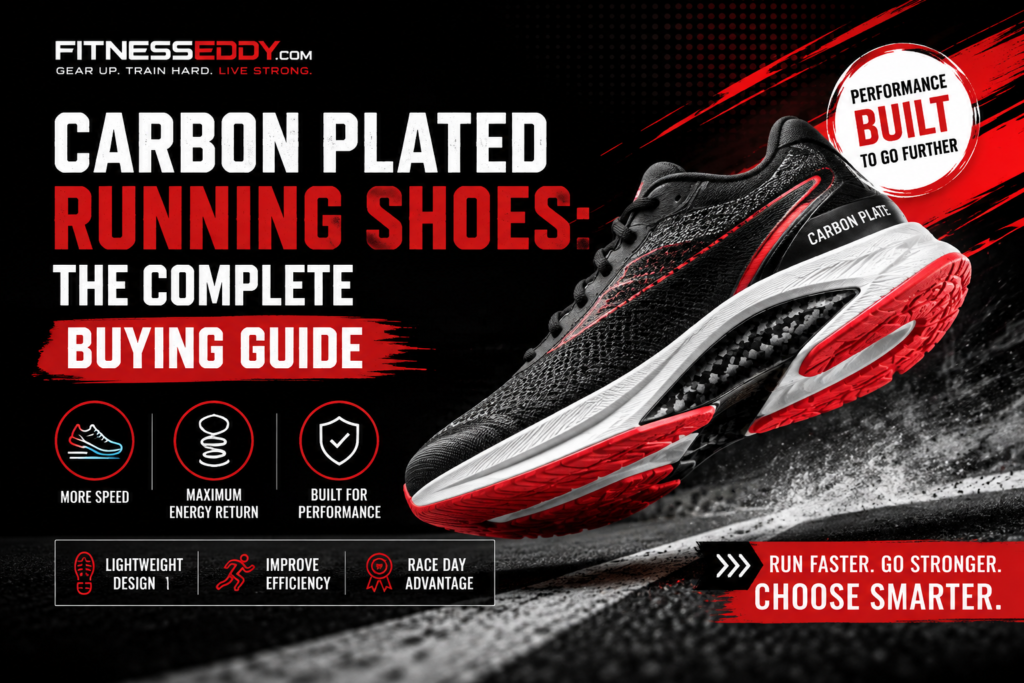
Carbon Plated Running Shoes: The Complete Buying Guide
Quick answer: Carbon plated running shoes — sometimes called “super shoes” — pair a stiff carbon-fiber plate with thick, high-rebound foam to store and return energy with every stride. They’re built for race day, tempo runs, and speed work, not easy daily miles. If you’re chasing a marathon PB or a 5K time, they’re one of the biggest single upgrades you can make to your kit. If you’re still building base mileage, a traditional trainer will serve you better.
Explore related Fitness Eddy guides and collections: affordable carbon plate running shoes · Performance Footwear
What Is a Carbon Plate in a Running Shoe?
A carbon plate is a thin, rigid sheet of carbon fiber embedded inside a shoe’s midsole foam, usually running the full length of the shoe from heel to toe. On its own, foam compresses and returns energy, but it also flexes and loses stiffness under load, especially through the front of the foot at toe-off. The plate acts like a lever: it resists that flex, keeps the foam working efficiently through the entire stride, and — combined with a rockered (curved) sole — helps roll the foot forward with less effort from the calf and Achilles.
Nike introduced the first carbon-plated racing shoe in 2016, and the category exploded after elite marathoners started smashing personal bests in them almost overnight. By 2019 the technology had moved from the road to the track. World Athletics stepped in a year later, capping competition shoes at a single carbon plate and a maximum stack height — which is why nearly every racing shoe on the market today, budget options included, uses one full-length plate rather than the multi-plate stacks found in those early prototypes.
Do Carbon Plate Running Shoes Actually Make You Faster?
For most runners, yes — within limits. A widely cited 2019 New York Times analysis of more than a million amateur race results found runners in carbon-plated shoes averaging 4–5% faster times than in traditional trainers, and lab studies on running economy have shown efficiency gains approaching 4% for some runners. The catch: the benefit is most pronounced at faster paces and tends to shrink the slower you run. On an easy 11-minute-mile jog, you likely won’t feel much difference — these shoes are optimized for effort, not comfort.
Carbon Plate Shoes vs. Racing Flats vs. Daily Trainers
It helps to see where carbon plate shoes sit in the lineup:
- Daily trainers — soft, durable, flexible. Built for logging miles comfortably, week after week.
- Racing flats — light and low to the ground, minimal cushioning, no plate. Favored for short, fast races where every gram matters.
- Carbon plate shoes — thick, high-rebound foam plus a rigid plate. The most cushioned option that’s still built for speed, which is why they’ve become the default choice for half and full marathons.
Most serious runners end up owning all three and rotating based on the workout — not because carbon plates replace the other two, but because they solve a different problem: making hard efforts feel more sustainable.
Who Should — and Shouldn’t — Wear Carbon Plate Running Shoes
Good fit if you’re:
- Training for a race and want a dedicated race-day shoe
- Running tempo runs, intervals, or speed workouts
- Chasing a specific time goal, from 5K to marathon
Think twice if you’re:
- New to running and still building basic mileage and form
- Prone to Achilles or calf issues — the rocker geometry changes your stride mechanics
- Looking for one shoe to do everything — a carbon plate is a specialist tool, not a daily trainer
Most coaches recommend logging the bulk of training in traditional shoes and saving the carbon-plated pair for race day and key workouts, both to protect its lifespan and to give your body time to adapt to the different mechanics.
How to Choose the Right Carbon Plated Running Shoes
| Feature | What to look for |
|---|---|
| Stack height | Higher stack = more cushioning and energy return, but less ground feel and stability |
| Plate stiffness | Stiffer plates suit efficient, faster runners; softer plates are more forgiving for newer racers |
| Weight | Race shoes typically run 6–8 oz; lighter isn’t always better if it costs durability |
| Drop | 4–8mm is standard for most carbon racers |
| Use case | Racing/tempo shoe vs. do-everything trainer — decide before you shop |
| Price | Premium models run $180–$250+; budget carbon-plate shoes start under $60 |
Fit matters more than any spec on this list. Carbon plate shoes run stiffer through the forefoot, so get a true measurement rather than guessing from your regular trainer size.
Premium vs. Budget-Friendly: Do You Need to Spend $200?
The carbon-plate market has two tiers. Premium racing shoes from major running brands — think $180 to $250+ — use proprietary foams and multiple production iterations to shave every possible second. They’re excellent, and if you’re chasing a Boston Qualifier, that R&D can be worth it.
But the core mechanism — a carbon plate in responsive foam — isn’t exclusive to premium price points. If you want to feel what a plated shoe does for your stride without the premium price tag, Fitness Eddy’s Carbon Plate Running Shoes – Men’s Marathon Racing Shoes ($53.31) is built around the same full-length plate concept, positioned for marathon and race-day training. It’s a low-risk way to test whether the carbon-plate feel works for your stride before committing to a premium pair.
Browse the full lineup in Performance Footwear if you’re comparing multiple pairs side by side.
Frequently Asked Questions
Are carbon plated running shoes worth it? Yes, if you race or do regular speed work. For easy runs and daily mileage, a traditional trainer is the better — and more durable — choice.
Are carbon plate shoes legal in competitive races? Yes. World Athletics permits shoes with a single carbon plate; multi-plate stacked designs were banned in 2020.
Can beginners wear carbon plate running shoes? They can, but most coaches suggest building a base in traditional trainers first. Carbon plates reward efficient form and can feel unstable until you’re used to the ride.
How long do carbon plate running shoes last? Roughly 200–300 miles, shorter than standard trainers. The foam is tuned for energy return, not long-term durability, so save them for key sessions rather than daily miles.
Can I wear carbon plate shoes for walking or daily training? You can, but it’s not what they’re built for. The firm ride and rocker shape are designed for running speed, not all-day comfort.
What’s the difference between carbon plate and regular running shoes? A carbon plate shoe uses a rigid plate inside thick, high-rebound foam to store and return energy. Regular trainers use softer, more flexible midsoles built for everyday cushioning rather than propulsion.
Do carbon plate shoes cause injuries? They can if you introduce them too quickly. The stiffer plate and rocker shape change your stride, so give your calves and Achilles time to adapt — start with shorter runs before racing in them.
What size should I get in carbon plate running shoes? Many runners size up half a size from their regular trainer, since the stiffer forefoot and thinner upper materials fit snugger than a standard daily shoe. Check the size chart for each specific pair before ordering.
Bottom Line
Carbon plated running shoes won’t fix bad training, but for the right runner, they’re one of the most effective upgrades in the sport. If you’re racing, doing tempo work, or chasing a PB, a plated shoe belongs in your rotation — and you don’t need to spend $200+ to find out if it works for you. Check out Fitness Eddy’s carbon plate running shoes and gear up for your next race.