
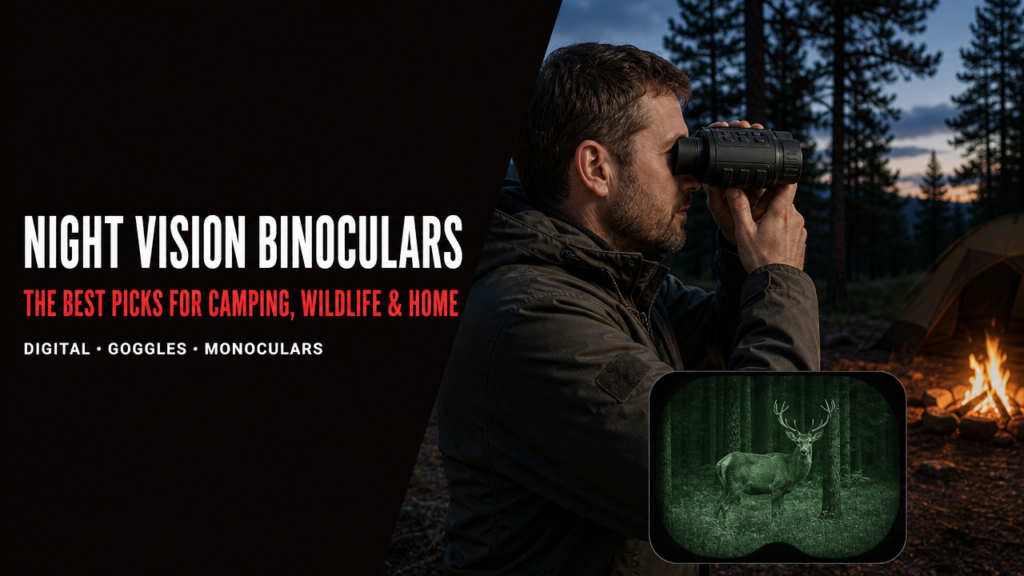
Short answer: the best night vision binoculars for most people are digital night vision binoculars with a built-in infrared (IR) illuminator. They work in total darkness, record photos or video, and cost far less than tube or thermal devices. Pick a binocular-style unit for comfortable two-eye viewing, a handheld or monocular unit if you want something light, and regular optical binoculars for dawn, dusk and daytime, when there is still some light.
We compared the digital night vision binoculars, goggles, monoculars and low-light optics in our range by type, listed range, magnification, screen and power, from $49.69 to $907.97. Prices in the product cards update live.
By the Fitness Eddy team. Updated October 2026.
Free shipping on every order, delivered in 5 to 7 days in the USA. 20% off your first order is applied automatically at checkout. 30-day returns. No code needed.
Good to know: every night vision device in this guide is digital infrared, not thermal. It shows a clear image in the dark with its IR light on, but it does not see body heat through fog, smoke or brush. Listed viewing ranges are best-case figures in full darkness.
Quick picks: the best night vision binoculars for your use
| Your use | Device type | Our pick | From |
|---|---|---|---|
| Wildlife watching and camping | Digital night vision binocular | V400B Digital Night Vision Binocular, 3.5 to 7x | $202.84 |
| Longest listed range | Digital night vision binocular | Infrared Night Vision Binocular, 600 m listed | $160.83 |
| Big, easy-to-read screen | Digital goggles, 5 inch LCD | Digital Infrared Night Vision Goggles | $209.83 |
| Light and fast to deploy | Handheld digital monocular | Handheld Infrared Night Vision, 4.3 inch screen | $257.19 |
| Two-tube style viewing | Dual-tube digital binocular | NV8000 Night Vision Instrument, 8x digital | $428.76 |
| Dawn, dusk and daytime | Optical binoculars, 12×42 | 12×42 BAK4 Binoculars | $90.05 |
| Pocket-size daytime optic | Mini binoculars, 10×22 | 10×22 Mini Pocket Binoculars | $91.85 |
Digital night vision vs tube night vision vs thermal
There are three ways to see in the dark. Knowing the difference saves you from paying for the wrong one.
| Digital night vision | Tube night vision (Gen 1 to 3) | Thermal | |
|---|---|---|---|
| How it works | Camera sensor plus an infrared light, shown on a screen | Image intensifier tube amplifies tiny amounts of light | Sensor reads heat, not light |
| Works in total darkness | Yes, with IR on | Needs some ambient light or IR | Yes |
| Daytime use | Yes, in color on most units | No, bright light can damage tubes | Yes |
| Records photo or video | Usually | Rarely | Some models |
| Sees through fog or brush | No | No | Better |
| Typical price | Lowest | High | Highest |
For most campers, hikers, homeowners and wildlife watchers, digital night vision is the best value. Tube and thermal devices make sense for professional or specialized use. The history and generations of night vision devices explain why tube units cost so much more.
How to read night vision binocular specs
- Magnification (for example 3.5 to 7x): how much closer things look. Higher zoom narrows the view and shows more shake.
- Objective lens (mm): the front lens size. Bigger lenses gather more light.
- IR illuminator: the built-in infrared light that makes digital night vision work in total darkness. Many use 850 nm IR, which can show a faint red glow.
- Listed range: a best-case distance with IR on in open, dark terrain. Expect to identify details at shorter distances.
- Screen size: larger screens are easier to read, especially with glasses.
- Recording: photo and video saved to a TF/microSD card.
- Power: built-in rechargeable, 18650 or AA batteries. Check whether batteries are included.
Best night vision binoculars (digital)
Binocular-style units are the most comfortable for long viewing sessions. The V400B Digital Night Vision Binocular has a 75 mm objective lens, 3.5 to 7x variable magnification and a listed range of 300 to 500 m. The Infrared Night Vision Binocular lists a 600 m range with a 3.7 V rechargeable battery, and the NV8000 Night Vision Instrument offers 8x digital zoom, USB charging and a headband mount in the box.
-
V400B Night Vision Binocular Digital Telescope Infrared
$202.84 Select options This product has multiple variants. The options may be chosen on the product page -
Infrared Digital Night Glasses Camera 600 M Night Vision HD Outdoor Binocular to Pinterest (opens in a new window)
Infrared Digital Night Glasses Camera 600 M Night Vision HD Outdoor Binocular
$160.83 Select options This product has multiple variants. The options may be chosen on the product page -
Night Double Tube Outdoor Night Vision Instrument
$428.76 Select options This product has multiple variants. The options may be chosen on the product page


Best night vision goggles and handheld monoculars
Goggles and handheld units trade some comfort for a lighter, faster setup. The Digital Infrared Night Vision Goggles have a 5 inch LCD and a listed 200 m range. The Handheld Infrared Night Vision Device starts in 1 second, has a 4.3 inch screen and an aluminum body rated for -30 to 60 °C. The RG55 Digital Monocular uses green imaging with a listed 150 to 250 m range, and the Hunting Night Vision Goggles come with or without an 18650 battery.
-
Digital Infrared Night Vision Goggles, 5 Inch LCD, 200 m Viewing Distance, Non-Thermal to Pinterest (opens in a new window)
Digital Infrared Night Vision Goggles, 5 Inch LCD, 200 m Viewing Distance, Non-Thermal
$209.83 Select options This product has multiple variants. The options may be chosen on the product page -
Handheld infrared night vision device
$257.19 Select options This product has multiple variants. The options may be chosen on the product page -
Digital Monocular Night Vision Infrared
$907.97 Select options This product has multiple variants. The options may be chosen on the product page -
Hunting night vision goggles
Price range: $220.58 through $269.65 Select options This product has multiple variants. The options may be chosen on the product page -
NV400B Digital Night Vision Camera
$314.41 Select options This product has multiple variants. The options may be chosen on the product page -
Monitoring infrared night vision device
$124.71 Select options This product has multiple variants. The options may be chosen on the product page


Best binoculars for dawn, dusk and daytime
Optical binoculars need some light, but they give a sharper, wider view than any digital screen when there is light to work with. The 12×42 binoculars use BAK4 prisms and multi-coated lenses. The 8×40 binoculars give a wider, steadier view, and the 10×22 pocket binoculars and 10×25 monocular fit in a jacket pocket.
-
Infrared night vision binoculars
$90.05 Select options This product has multiple variants. The options may be chosen on the product page -
Night vision telescope high power
$158.29 Select options This product has multiple variants. The options may be chosen on the product page -
10×22 Mini Pocket Binoculars – Compact Optical Telescope with Cloth Bag to Pinterest (opens in a new window)
10×22 Mini Pocket Binoculars – Compact Optical Telescope with Cloth Bag
$91.85 Select options This product has multiple variants. The options may be chosen on the product page -
Outdoor binoculars 10×25 small Paul High-definition mini portable low-light night vision to Pinterest (opens in a new window)
Outdoor binoculars 10×25 small Paul High-definition mini portable low-light night vision
Price range: $49.69 through $116.03 Select options This product has multiple variants. The options may be chosen on the product page


What people use night vision for
- Wildlife watching: deer, owls, raccoons and other nocturnal animals without a flashlight that scares them off.
- Camping and hiking: checking the campsite edge and trail at night.
- Home and property: looking over a yard, barn or driveway after dark.
- Boating and fishing: spotting markers and shorelines. Never use it in place of proper navigation lights and charts.
- Hunting: scouting and recovery where your state allows it.
Is night vision legal in the US?
Yes. Owning digital night vision binoculars is legal for civilians in all 50 states. Using night vision for hunting is a different matter: rules depend on your state, the species and the season, so check your state wildlife agency before you hunt with it. Some night vision devices are also export-controlled, so check the rules before taking one outside the United States.
Care and battery tips
- Charge or replace batteries before every trip. IR use drains them fastest.
- Carry a spare 18650 or AA set if your device uses them.
- Keep lens caps on in daylight and clean lenses with a microfiber cloth.
- Format the memory card in the device before your first use.
- Store devices dry, and let them warm up slowly after cold nights to avoid condensation.
Frequently asked questions
Do digital night vision binoculars work in total darkness?
Yes, with the built-in IR illuminator on.
What is the difference between night vision and thermal?
Night vision shows light (including IR). Thermal shows heat and sees through fog and brush better.
How far can night vision binoculars see?
Our listed ranges run from about 150 to 600 m. Real-world detail is shorter.
Can I use night vision binoculars during the day?
Yes. Most digital units work in daylight, usually in color.
Is night vision legal to own in the US?
Yes. Hunting with it depends on your state, species and season.
Do I need a memory card?
Only to save photos or video. Most use a TF/microSD card.
Keep reading
- Tactical backpacks and EDC bags: how to choose
- Tactical vest vs plate carrier vs chest rig
- How to choose hiking shoes and boots
Not sure which device fits your use? Tell us what you want to watch and how far away through our contact page, and we will recommend one, usually within 24 hours.