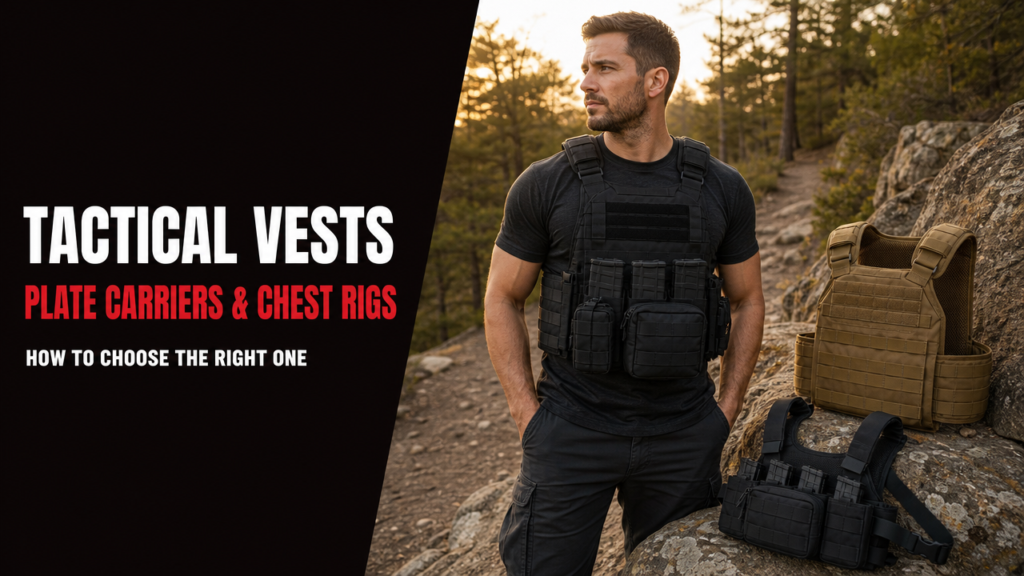
Short answer: when you compare a tactical vest vs plate carrier vs chest rig, pick a tactical vest for hiking, range days and training with lots of pockets, a plate carrier if you want a low-profile frame for plates or weight and a quick-release harness, and a chest rig if you only need magazines, a phone and small kit up front with the most airflow. Look for 600D to 1000D fabric, MOLLE webbing and adjustable shoulder and side straps.
We sorted the vests, plate carriers and chest rigs in our range by job, from $23.10 to $277.41, with fabric, fit and use cases side by side. Prices in the product cards update live.
By the Fitness Eddy team. Updated October 2026.
Free shipping on every order, delivered in 5 to 7 days in the USA. 20% off your first order is applied automatically at checkout. 30-day returns. No code needed.
Important: the plate carriers in this guide are sold as carriers only. Armor plates are not included, and none of these vests are body armor or rated for ballistic protection. If you need certified protection, look for armor tested to the National Institute of Justice (NIJ) body armor standard.
Quick picks: which vest for which job?
| Your goal | Best pick | From |
|---|---|---|
| Hiking and outdoor training | 800D Waterproof Oxford Tactical Vest | $63.98 |
| All-season training, heavy use | Heavy-Duty Tactical Training Vest, 600D | $72.50 |
| Plate carrier on a budget | Tactical Plate Carrier Vest with MOLLE & Mag Pouches | $68.99 |
| Quick-release harness | Nylon LAVC Quick-Release Tactical Vest | $148.99 |
| Light chest rig for trail runs | Tactical Chest Pack Rig | $44.99 |
| Weighted training and rucking | Adjustable Weight Training Vest | $247.78 |
| Everyday streetwear look | ICONS Tactical Streetwear Vest | $54.31 |
Tactical vest vs plate carrier vs chest rig: the key differences
The tactical vest vs plate carrier choice comes down to coverage and load. All three carry gear on your torso, but they are built for different jobs. The right one depends on how much you carry and how long you wear it.
| Tactical vest | Plate carrier | Chest rig | |
|---|---|---|---|
| Coverage | Full torso, front and back | Front and back panels, open sides | Chest only |
| Best for | Hiking, range days, training, outdoor work | Plates or training weight, structured load | Running, light carry, hot weather |
| Storage | Many fixed pockets plus MOLLE | MOLLE panels and mag pouches | A few pouches up front |
| Airflow | Medium | Medium to good | Best |
| Weight on you | Spread across the torso | Concentrated on the shoulders | Lightest |
How to choose a tactical vest: 6 things that matter
1. Fabric strength (the D number)
Denier (D) measures how thick the nylon or Oxford fibers are. 600D is light and flexible, 800D to 900D is a good all-round middle, and 1000D is the toughest and stiffest. For hiking and casual training, 600D to 800D is plenty. For daily hard use or heavy loads, go 900D to 1000D.
2. MOLLE webbing
MOLLE is the grid of horizontal straps that lets you attach pouches anywhere on the vest. More MOLLE means you can rebuild the vest for each activity: a med kit for the trail, mag pouches for the range, a phone pouch for daily carry. Browse MOLLE pouches and EDC gear to add on.
3. Fit and adjustability
Most tactical vests are one size with adjustable shoulder and side straps. Measure your chest at its widest point over the clothes you will wear underneath, then compare it with the listing. The vest should sit snug enough not to bounce when you jog, but leave room to take a full breath.
4. Weight and load
An empty vest usually weighs far less than what you put in it. Plan your full kit first. If you will carry more than a few pounds, choose a vest with a padded back panel and wide shoulder straps, or a plate carrier that spreads the load.
5. Quick release
A quick-release harness lets you drop the vest in one pull. It is useful for water activities, training drills and anyone who takes the vest on and off often.
6. Color and pattern
Black and ranger green look clean and urban. Coyote, khaki and wolf brown suit desert and dry trails. ACU, CP (multicam-style) and woodland camouflage blend into mixed terrain. Pick the color that matches where you actually go.
Best tactical vests for hiking and training
These full-torso vests give you the most pockets and MOLLE space. The 800D Waterproof Oxford Tactical Vest is the easiest place to start for outdoor use, and the Heavy-Duty Tactical Training Vest is our pick for year-round training. The 900D Oxford Sport Utility Harness adds a stiffer back for heavier loads.
-
800D Waterproof Oxford Tactical Vest, Black, ACU, Forest Green, Khaki to Pinterest (opens in a new window)
800D Waterproof Oxford Tactical Vest, Black, ACU, Forest Green, Khaki
Price range: $63.98 through $69.10 Select options This product has multiple variants. The options may be chosen on the product page -
Heavy-Duty Tactical Training Vest – 600D Oxford Nylon, All-Season Combat Ready Gear to Pinterest (opens in a new window)
Heavy-Duty Tactical Training Vest – 600D Oxford Nylon, All-Season Combat Ready Gear
$72.50 Select options This product has multiple variants. The options may be chosen on the product page -
Outdoor Adventure Equipment Camouflage Tactical Vest
Price range: $79.64 through $81.42 Select options This product has multiple variants. The options may be chosen on the product page -
Heavy Duty Tactical Vest 900D Oxford Sport Utility Harness – Premium And Universal Size to Pinterest (opens in a new window)
Heavy Duty Tactical Vest 900D Oxford Sport Utility Harness – Premium And Universal Size
$135.79 Select options This product has multiple variants. The options may be chosen on the product page -
Men Tactical Vest
$65.00 Select options This product has multiple variants. The options may be chosen on the product page -
Tactical Multi-functional MOLLE Lightweight CS Outdoor Training Tactical Vest to Pinterest (opens in a new window)
Tactical Multi-functional MOLLE Lightweight CS Outdoor Training Tactical Vest
$180.19 Select options This product has multiple variants. The options may be chosen on the product page


Best plate carriers and quick-release vests
Plate carriers trade some pockets for a lower profile and a structured frame. The Tactical Plate Carrier Vest includes three magazine pouches and adjustable straps at a friendly price. The LAVC Quick-Release Vest and the Quick-Release Protective Waistcoat add a fast-drop harness. Plates are not included.
-
Tactical Plate Carrier Vest with MOLLE & Mag Pouches
$68.99 Select options This product has multiple variants. The options may be chosen on the product page -
Nylon LAVC Quick-release Multifunctional Tactical Vest
$148.99 Select options This product has multiple variants. The options may be chosen on the product page -
Tactical Outdoor Military Fans Quick Release Tactical Vest Protective Waistcoat to Pinterest (opens in a new window)
Tactical Outdoor Military Fans Quick Release Tactical Vest Protective Waistcoat
Price range: $277.41 through $278.19 Select options This product has multiple variants. The options may be chosen on the product page -
Tactical camouflage JPC lightweight vest vest
$167.00 Select options This product has multiple variants. The options may be chosen on the product page -
CS Tactical Vest – Camouflage Amphibious Tactical Outdoor
Price range: $153.46 through $166.84 Select options This product has multiple variants. The options may be chosen on the product page -
Replica Classic M-1 Equipment Outdoor Camouflage Sports Vest
$201.88 Select options This product has multiple variants. The options may be chosen on the product page


Best chest rigs for running and light carry
A chest rig keeps essentials in front of you and leaves your back open for a pack and airflow. The Tactical Chest Pack Rig is built for trail running, the Multifunctional Tactical Chest MOLLE gives you more pouch space, and the MK5 Split Chest Hanger is a modular Cordura setup.
-
Tactical Chest Pack Rig- Multi-functional Suitable For Trail Running to Pinterest (opens in a new window)
Tactical Chest Pack Rig- Multi-functional Suitable For Trail Running
$44.99 Select options This product has multiple variants. The options may be chosen on the product page -
Multifunctional Tactical Chest Molle
$85.32 Select options This product has multiple variants. The options may be chosen on the product page -
MK5 Split Tactical Chest Hanger
$111.63 Select options This product has multiple variants. The options may be chosen on the product page


Weighted vest for rucking and conditioning
If your goal is fitness rather than carry, a weighted vest adds load to walks, step-ups and bodyweight work. The Adjustable Weight Training Vest comes in several weight options. Start light, around 5 to 10% of your body weight, and build up over weeks.
-
Tactical Training Outdoor Running Adjustable Weight Vest
Price range: $247.78 through $579.70 Select options This product has multiple variants. The options may be chosen on the product page


Tactical-style vests for everyday wear
Want the utility look without a full loadout? These streetwear vests have the military styling and extra pockets but wear like regular outerwear.
-
ICONS Tactical Streetwear Vest – Fashion Military Style
$54.31 Select options This product has multiple variants. The options may be chosen on the product page -
Street-Style Tactical Vest, One Size, 8 Colors from Army Green and Black to Orange and Red to Pinterest (opens in a new window)
Street-Style Tactical Vest, One Size, 8 Colors from Army Green and Black to Orange and Red
$69.70 Select options This product has multiple variants. The options may be chosen on the product page -
Tooling Tactical Sports Fashion Solid Color Vest
$23.10 Select options This product has multiple variants. The options may be chosen on the product page


How to fit and adjust your vest
- Loosen every strap before you put it on.
- Set the shoulder straps first so the top of the front panel sits just below your collarbone.
- Tighten the side straps until the vest is snug but you can still take a deep breath.
- Load your pouches, then walk, crouch and jog in place. Re-tighten anything that shifts.
- Keep the heaviest items close to your center and high on your torso.
Care tips that make a vest last
- Empty all pouches and brush off dirt after every outdoor trip.
- Hand wash in cool water with mild soap. Avoid bleach and the dryer.
- Air dry out of direct sun so colors do not fade.
- Check stitching on the shoulder straps and MOLLE rows every few months.
Frequently asked questions
Tactical vest vs plate carrier: what is the difference?
A tactical vest covers your whole torso with many fixed pockets and is built for carrying gear. A plate carrier has front and back panels that hold plates or training weight, with MOLLE for pouches and open sides for airflow.
Do these plate carriers come with armor plates?
No. They are sold as carriers only. Plates are not included, and none of these vests are body armor or rated for ballistic protection.
What does 600D, 900D or 1000D mean?
It is the fabric denier, a measure of fiber thickness. Higher numbers are tougher and stiffer. 600D to 800D suits hiking and casual training, 900D to 1000D suits heavy daily use.
Is a tactical vest good for hiking?
Yes. A light 600D to 800D vest keeps water, snacks, a phone and a first aid kit within reach and spreads the weight across your torso instead of one shoulder.
How should a tactical vest fit?
Snug enough that it does not bounce when you jog, with room to take a full breath. Set the shoulder straps first, then the side straps, then test it loaded.
What is MOLLE?
MOLLE is a grid of horizontal webbing straps that lets you attach and move pouches anywhere on the vest, so one vest can be set up for different activities.
Keep reading
- Best concealed carry shirts and holsters for men
- How to choose hiking shoes and boots
- Best tactical backpacks and EDC bags \n\n
- Best night vision binoculars \n\n
- Shop all tactical and outdoor gear
Not sure which vest fits? Send us your chest and waist measurements through our contact page and we will check them against the listed fit, usually within 24 hours.